


There is a particular quality to Ramzan in Pakistan that is hard to explain to someone who hasn’t felt it. The country doesn’t slow down for the month, it recalibrates. The streets empty at iftar and fill again two hours later. Offices run on a different clock. Chai never arrives, conversations run longer, and the sense of collective purpose sits in the air like Karachi’s humidity. It’s the kind of atmosphere that makes everything feel slightly more urgent and slightly more tender at the same time.
For a fundraising campaign, that atmosphere is both a gift and a pressure test.
Pakistan is the source market for The Citizen’s Foundation. The mission lives here. The schools are here, the students are here, the teachers driving down dusty roads before 7am are here. When you’re asking a Pakistani donor to give, you are not asking them to imagine a problem happening somewhere far away. You are asking them to give to something they may have passed on the way to work. That proximity changes the texture of the ask. It also changes what the audience demands from the creative.
The audience that wouldn’t stop watching
The number that stopped me in my tracks wasn’t revenue. It was completion rate.
On YouTube, Pakistan’s audience completed our 30-second direct-to-camera video at a rate of 63.73%. These are not industry-standard numbers. Globally, video completion rates in this range are exceptional.
More importantly, completion rates held even at scale, which tells you something specific about the local audience: they are not passive scrollers. They are watching. And if the content is honest and the storytelling is rooted, they will stay until the end.
Wasim Akram drove the highest click-through rate of any YouTube asset in the market at 3%. A face that generations of Pakistanis grew up watching, appearing in a 30-second appeal during Ramzan, on a YouTube pre-roll. What the data confirmed is that the click-through is earned, not assumed. The celebrity hook stops the scroll. The storytelling that follows earns the watch. Get either wrong and the numbers tell you immediately.
The T20 and the timing site
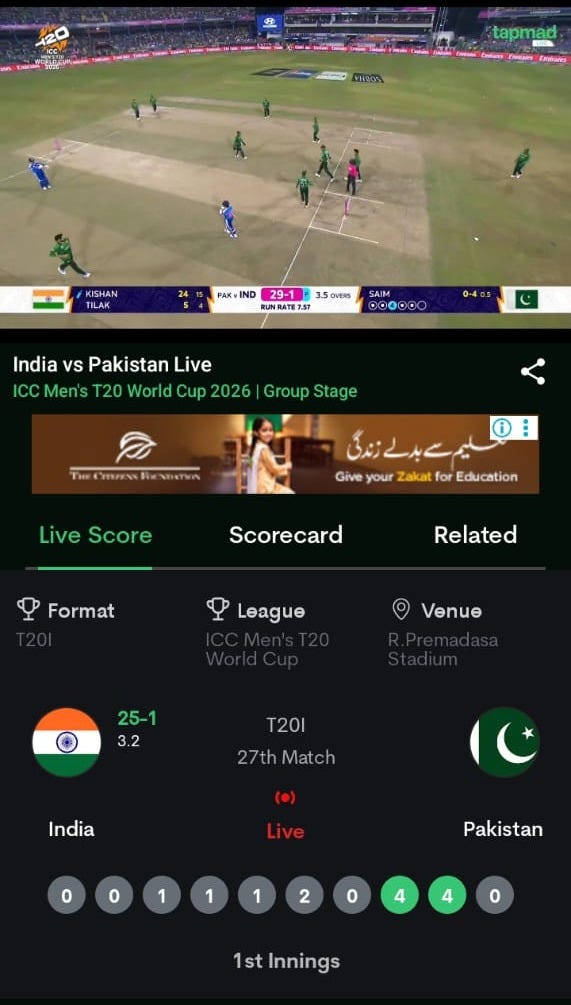
During Ramzan this year, Pakistan was also hosting the ICC T20 Cricket World Cup. Cricket in Pakistan is not simply sport, but the background noise of the country and the reason a group of strangers in a dhaba will start talking to each other. During a match, the entire country is watching the same thing at the same time.
We used Tapmad and Myco, broadcasting platforms streaming the matches, to place TCF adverts in front of that audience. The logic was simple: if your target audience is watching a T20 match at 8pm during Ramzan, be in that moment with them. Not intrusively. Contextually. An advert for a cause they care about, in a medium they chose to be in, during a season they are already thinking about giving.
The other placement that worked with similar precision was Hamariweb. It is the most visited resource globally for people searching sehri and iftar timings, not just in Pakistan, but across the Pakistani diaspora worldwide. Every day during Ramzan, millions of people open it to check when to eat and when to pray. We placed TCF adverts directly into those timing pages. The CPM was efficient. The intent of the person viewing the ad, in that moment, was as close to perfect as a placement gets. Someone asking “what time is iftar today” is already in a Ramzan mindset. They are thinking about obligation, about fasting, about the day’s rhythm. The distance between that state of mind and a Zakat donation is shorter than almost any other moment in the media landscape.
Publishers, in Pakistan, are not an afterthought. ARY News and DAWN News, the two most trusted news sources for the Pakistani audience, ran TCF placements during sehri and iftar windows. The moment a person opens a news app at 5am to read while waiting to eat, or at 6pm while the iftar table is being set, is a moment of low distraction and high receptivity. We were in those moments deliberately.
What the creative data actually said
We ran 100+ assets across the campaign. One of the more decisive tests we ran was language. English creative versus Urdu; same message, same visual, different tongue. The Urdu versions converted at 2.4x the rate of the English equivalents.
It sounds obvious in retrospect. Pakistan is an Urdu-speaking country. But the instinct in many campaigns, especially those run from a global template, is to default to English because it travels. However, while most Pakistani’s can read and converse in English, Urdu still holds a stronghold when targeting retail donors and the numbers supported it (2.4x more conversions in Urdu creatives).
Search: where intent becomes money
Branded search in Pakistan generated the most conversions from any channel (obvious). Non-branded generated roughly a third of that revenue from just over half the conversions. Both channels worked. But they are doing completely different jobs.
The branded search donor has already decided. They researched, they heard, they considered, through creative, through P2P, through a conversation, through years of accumulated trust, and now they are executing. They give more per transaction because they arrived with purpose. Branded search is where your existing and recurring donor base completes the loop. It is the harvest of everything you built upstream. Underfund it and you leave your most loyal donors without a clean path to give. That is an unforgivable mistake during Ramzan.
Non-branded is a different story and an equally important one. The person who typed “Zakat organisation Pakistan” or “best place to give Zakat online” has not considered you as a viable option yet, and if they do, they will convert at a lower rate and a lower ticket size, and that can make non-branded look like the less glamorous channel on a dashboard. But it isn’t. Every single one of those conversions is a new donor. Someone who did not exist in your database yesterday. If you bring them in well, give them a good first experience, and stay in front of them, they become the branded search donor of next Ramzan.
Treat non-branded search as a recruitment channel, not a revenue one.
Pakistan is not behind. It is early.
There is a tendency, in global fundraising conversations, to treat Pakistan as a high-potential market that hasn’t quite arrived yet, a place with enormous generosity but underdeveloped digital infrastructure. However, the data from this Ramzan disagrees.
Pakistan’s audience watches longer than international benchmarks. It clicks at competitive rates. It searches in volume. It has high-value donors giving at scale through digital channels (multiple transactions in the millions of rupees through Zakat alone). The digital giving market in Pakistan is not nascent. It is active, engaged, and waiting to be met with the same quality of strategy that any mature market deserves.
The ceiling, for a campaign that builds brand upstream and serves creative that respects the audience’s intelligence, is not where most people imagine it is.
Ramzan in Pakistan is thirty days of extraordinary noise and extraordinary generosity. The work is to be specific enough, honest enough, and early enough to be heard above both.
-Moebin