


Every market in this campaign had a challenge. Canada lost its Meta account. The Gulf markets were witnessing a war. Pakistan had noise at scale. But the UK presented a problem that no pivot or tactical adjustment could fully solve, because it is structural, cultural, and it has been there long before this campaign began.
The UK Islamic charitable sector is one of the most competitive giving environments on earth. It is not just that the major global NGOs are fighting for attention, but also that the local mosque two streets away is running its own Ramzan appeal. The community masjid in Bradford, the Islamic relief committee in Birmingham, the WhatsApp group fundraiser for a family in Gaza, they are all competing for the same donor, during the same 30 days, with a legitimacy that comes from proximity and community trust that no national organisation can manufacture.
The UK donor, shaped by this environment, has developed a specific giving behaviour: they spread. Rather than committing a significant Zakat to one institution, they distribute across multiple causes. I like to call it generosity by portfolio. It is also, from a campaign optimisation standpoint, the reason the UK’s average donation per conversion is the lowest of any market globally, lower even than Pakistan, despite the UK donor having significantly higher purchasing power.
With the same number of conversions as other major markets with a fraction of the average gift, the ROI equation in the UK is harder than anywhere else we operate.
The first week and the pivot
We went into Ramzan with a standard creative strategy. By the end of the first week, the numbers were telling us something was wrong. Not catastrophically wrong; conversions were coming in, the campaign was running, but the revenue trajectory was trailing behind where it needed to be. The average gift was low, and it was not moving.
The diagnosis was straightforward once we looked at it clearly. We were capturing donors who were allocating a portion of a distributed giving budget to TCF. We were getting a share. What we needed to do was earn more of it.
We did two messaging pivots:
First, we optimized for monthly giving. A donor who commits to a monthly amount over 12 months does not think of themselves as giving twelve times. They think of themselves as making one decision. The monthly framing reframes the ask from “how much do you want to give today” to “how would you like to support this over time.” For a donor already spreading across multiple causes, a monthly commitment to one of them creates a different kind of relationship than a one-time gift. It builds loyalty into the transaction from the start.
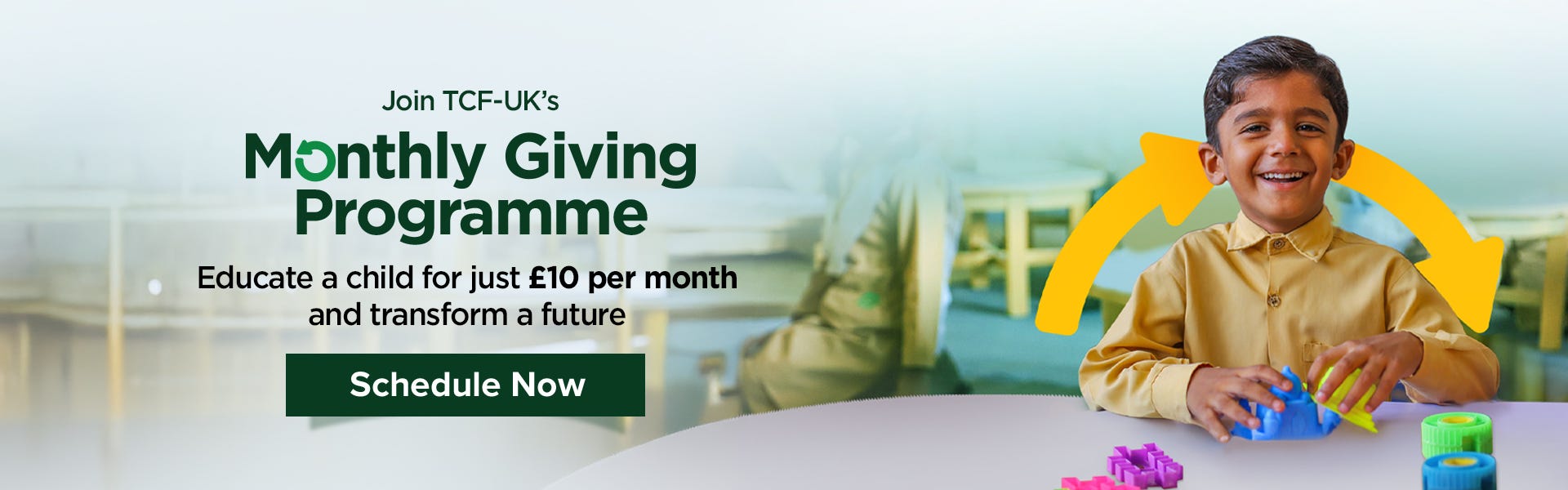
Second we pushed support-a-child pricing. This ask comes with a pre-set price point, which encouraged donors to give more.
Both pivots moved the numbers, and the campaign recovered its trajectory through the second and third weeks.
YouTube and Meta: the same donor, different brains
The UK produced the clearest platform split of any market in the campaign. On YouTube, the CEO’s credibility-led appeal achieved the highest completion rate. The celebrity creative had the lowest. The UK YouTube audience is not interested in being told what to do by a famous face but want to understand why.
On Meta however we saw the exact opposite. The celebrity video led results. The same donor, on a different platform, in a different mode of consumption, responded to a completely different creative register.
This is not contradictory. YouTube is a lean-forward environment and the audience chose to be there, they are watching with some intention, they have higher tolerance for content that requires something from them. Meta is a lean-back environment where the audience is scrolling, half-distracted, and the creative has seconds to interrupt and redirect.
The UK data makes this the most explicit case study of platform-native creative in the entire campaign. An asset that worked on one platform would have underperformed on the other. Running the same creative across both would have left significant performance on the table.
The ARPU problem and what to do about it
The low average gift in the UK is not going to be solved by a single campaign. It is a market condition, and treating it otherwise leads to frustration and misread data.
What can be addressed is the share of the distributed giving budget that goes to TCF. Monthly giving and support a child pricing is part of the answer. However brand building over time is the longer part of the answer. A donor who has encountered TCF across multiple Ramzans, through multiple channels, in multiple contexts, eventually stops treating it as one of many options and starts treating it as a default.
The UK is a market where patience is not optional. The conversion numbers are competitive. The donor intent is real. The community is large and genuinely generous. The work is to earn a larger share of a distributed budget, consistently, year after year, until TCF becomes the cause that gets the committed allocation rather than the discretionary one.
While work is obviously slow, it is also the only work worth doing here.
What the UK teaches you about humility
Every other market in this campaign had a clear strategic lever: Start early, build the creative, fund the search and follow the data. In the UK, you do all of those things, and the market reminds you that it has its own logic and it will not be rushed.
The UK donor is not harder to reach neither are they less generous. They are more contested, more distributed, and more loyal to the community structures that fundraising from a distance will always struggle to replicate. The mosque appeal has a legitimacy that comes from shared space, shared prayer, shared iftar and no digital campaign fully matches that.
What digital can do is be present enough, credible enough, and specific enough that it earns a place in the portfolio.
The UK campaign ended in a better position than it started. The pivot to monthly giving and pricing-specific messaging worked and the platform strategy was validated.
-Moebin