

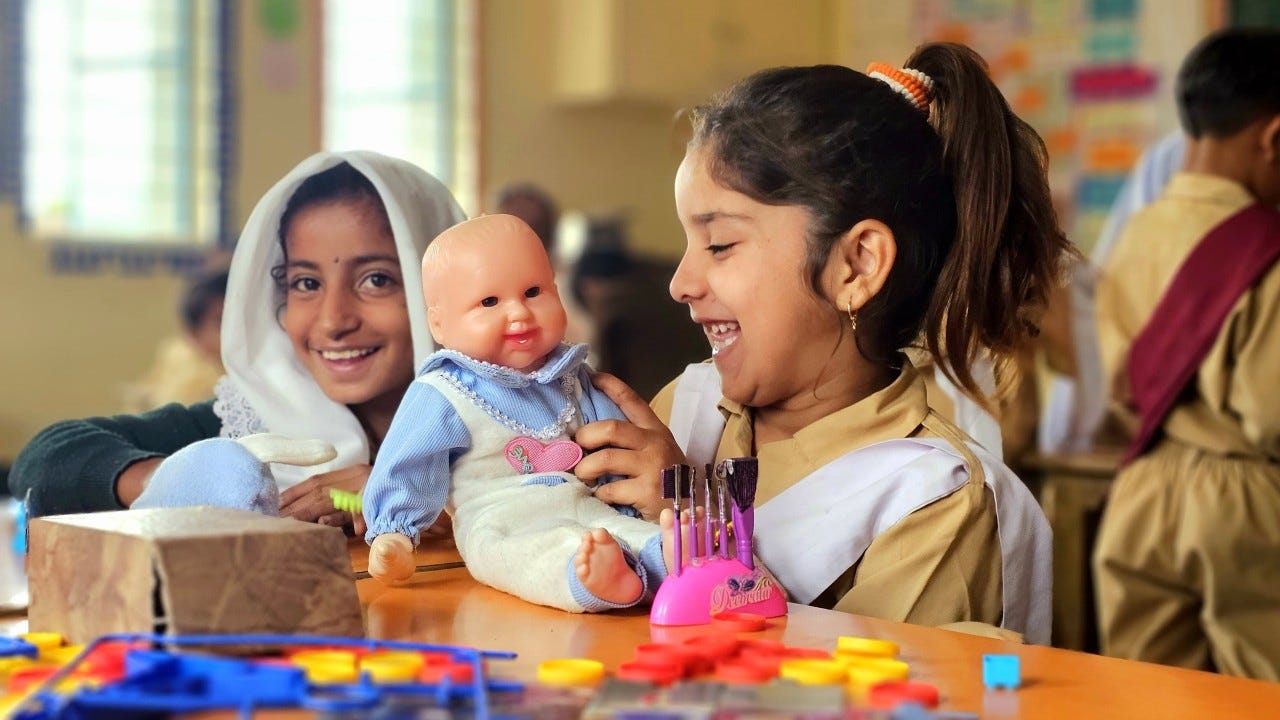
Somewhere in Pakistan, in a low-income neighbourhood that most maps don’t bother to detail, there’s a school that looks different from its surroundings. It stands tall, visible and intentional. There are over thousands of them.
The Citizens Foundation (TCF) is the largest network of privately run schools in the world. Founded in 1995 by a group of Pakistani businesspeople who believed that education was the only lever worth pulling, it now serves 320,000+ students across Pakistan, funded almost entirely by donors: individuals, families, and diaspora communities spread across North America, Europe, the GCC, and APAC.
From the outside, you can’t fully grasp its scale, and that’s by design. TCF doesn’t spend its time taking credit; it shines the light on its most valuable stakeholders: its students and alumni. Inside, you feel the size differently. You learn to speak to two very different rooms at once: some of the most influential people in society who can propel a mission forward, and the most underserved communities the organisation exists to serve.
People inside TCF often say you learn more than a job here. That’s true. It tunes your values, your perspective, your pace. I learned to slow down without slowing down: to breathe, gather context, and resist the easy, obvious decision when a better one is a few questions away. Decisions here are made in a painstaking, almost pedantic way - not because of bureaucracy, but because the mission dictates it. TCF feels less like an organization and more like a living organism: students, teachers, management, donors, volunteers, founders, many different parts working towards the same goal.
The macro lens: retail giving is rising, but how can you be at the forefront of strategy?
The business world typically adopts digital in waves: pioneers -> startups -> SMEs -> corporates -> fundraising. And innovation often travels from the US outward with a lag. Take creator‑facing content as an example(direct‑to‑camera hooks, crisp transitions, explicit CTAs): they were mainstream in the US by 2020, but Pakistan began embracing it around 2023/2024. If you’re outside the US, or simply outside the pioneer wave, you have a stretegic advantage: you can see what’s working elsewhere and adopt it earlier in your market. That means lower cost per goal than the benchmarks.
For fundraising, especially at TCF, this matters. Retail tactics translate remarkably well if you respect context. Build the brand so that search can capture real intent (unknown charities don’t convert on branded or unbranded search // credibility matters here). Use Meta to create both demand and conversion. Lead with video, still the most persuasive format today, but close with statics (better conversion driver) within the same campaign. Focus relentlessly on creative - forget the old interest based targeting strategy; do creative targeting instead.
Creative targeting in practice: If you have three audience “interests,” spin them into three creatives with distinct hooks for each interest cluster, then run broad/open. Let the algorithm find pockets of efficiency. You’ll often see frequency spike beyond what “best practice” says (I’ve seen 20+). That’s the algo learning who actually cares. If your brand, message, and landing journey are dialed, the unit economics will catch up.
What we saw: in the first five months, we lifted ROI by +2.5 percentage points in Pakistan and +4.2pp in the US, with ~20% less spend (and yes, revenue climbed too, no manipulating numbers here lol).
Industry signals (that matched what we felt on the ground)
Paid Search: Classic keyword campaigns got pricier and less efficient for many nonprofits, while Performance Max helped backfill search‑like inventory and soften the blow. Search is still a capture channel, but you need brand heat upstream and modern campaign types to hold the line.
Social: Teams going all‑in on Meta Advantage+ continued to find scale for new-donor acquisition. Gift sizes can be lower, but the volume and ARPU/CAC can be right if your creative is strong.
Display/CTV: Performance was uneven in display as AI reshapes web traffic quality, while Connected TV proved steadier, another reason to be choosy with programmatic and keep creative modular for video surfaces.
Creative: Direct‑to‑camera, human, straightforward creative outperformed “over‑produced.” Dynamic elements (time of day, region, weather) added lift in some cases, proof that context personalisation beats glossy aesthetics.
My operating system: KISS, but make it rigorous
(KISS - Keep It Simple, Stupid)
It’s easy to drown in dashboards. At scale, simplicity doesn’t remain a cliché.
Name the goal. (Let’s use conversion as the template.)
Define the journey. (App event, web event, lead - pick one and make the downstream measurement airtight.)
Write the why. Why would this audience convert now? Do the values research; don’t guess.
Overproduce creative. Hooks, lengths, formats. Refresh on a cadence.
Pick core KPIs and be religious. For conversions I would usually use CAC vs. ARPU (or LTV/CAC if you can measure it at pace). Guard these like a hawk.
Use the KPIs as levers for early warning. (CAC creeping up? Revisit the campaign, refresh creatives, etc)
Standout Creative: How One 15‑Second Video Moved the Needle
One of the strongest creatives we produced in these first five months was a short, vertical video built around a clear, human, high‑impact hook on girls’ education. It opened with an immediate, values‑driven line and an office‑floor setting with real team members speaking from their lived perspective, direct‑to‑camera style that continues to outperform highly produced content across nonprofits and social platforms. Industry-wide, candid, human‑sounding creative has been outshining polished assets, especially in social and video formats.
Why it worked
Strong visual + audio hook (first 1–3 seconds): Emotional clarity tied to girls’ education and attention won by immediacy and authenticity.
Faces behind the mission: Office setting and team voices created “trust proximity” (credibility rises when audiences see the people doing the work).
Clarity of value: On‑screen text (“TCF is breaking barriers to girls’ education”) plus tight transitions explained the how behind the impact.
Craft choices: Subtitles for silent viewing; quick transitions to maintain pace; consistent brand cues to reinforce the message.
The numbers: CTR above 3%, solid for mid‑funnel awareness to consideration in nonprofit video. Because search acts as a brand demand harvester, videos like this directly support better capture efficiency downstream.
Where it fits in the machine: We treated this creative as one of the hook variants in a broad/open Meta setup and as a top‑of‑funnel spark for Shorts/Reels. It brought direct conversions and also seeded brand demand that we later harvested in branded search, keeping CAC stable while spend dropped.
The retail‑to‑fundraising translation (quick hits)
Brand → Search: You won’t win on search without brand demand. Treat search as a harvesting function of brand/creative work.
Meta for dual intents: Build reach and convert, but let creative carry the segmentation. Advantage+ + open targeting + creative variety > interest micromanagement.
Video first, but don’t loose on statics: If a picture is worth a thousand words, a sincere 15‑second face‑to‑camera is worth a thousand clicks.
Programmatic skepticism: Display is noisy right now; invest where attention is real.
What TCF taught me about pace and perspective
At TCF, I learned to be ambitious about outcomes but patient about inputs. To sit with context until the right answer surfaces. To design for humans (teachers, parents, alumni, donors) before I design for algorithms. Most of all, I learned that when the mission is big enough, the work calibrates you: you exhale, you think, you choose well - and then you move fast.
Ramadan will bring its own curveballs and learning loops. I’ll write that chapter when the dust settles. For now, these are the notes from my first five months. If you’re building or scaling digital fundraising anywhere in the world, I hope this helps you ship better decisions, one simple step at a time.
-Moebin